
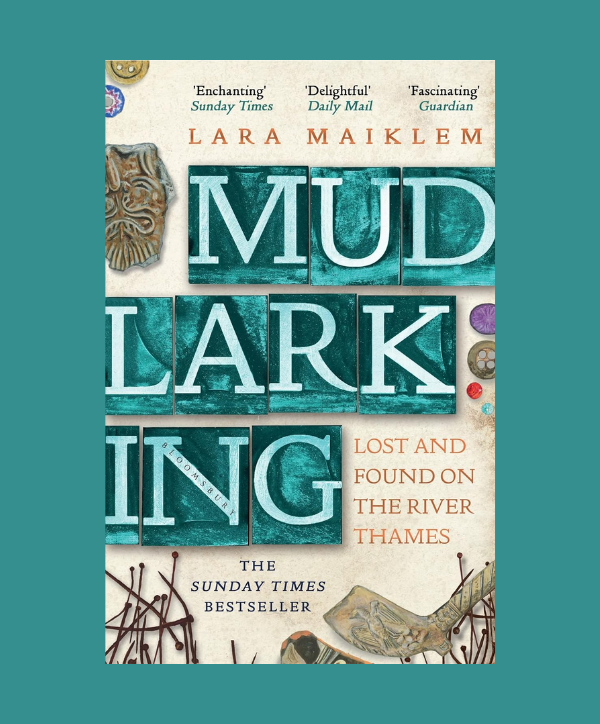
I know that on these pages we mostly talk about crime fiction. The book reviews are, after all, mostly written by the Oundle Crime Book Group. But on and off I like to tell you about something else I have read. This time it is a piece of astonishing non-fiction called Mudlarking by Lara Maiklem.
Lara Maiklem is a London Mudlark – someone who searches a river’s edge for finds. Maiklem works along the Thames, from its tidal reach to the estuary which is the ideal place for a Mudlark, as she explains in this wonderful book. The daily tides move not just water but also items that have been lost in the river, some recent, some years, decades or even centuries in the past, and then the river brings them to the surface of the foreshore for a Mudlark like her to find.
Mudlarks mostly used to be destitute people, searching for a living among the rubbish thrown into the river. But no longer. Who knew that a Mudlark has to have a permit to work? To get this you have to have belonged to the Society of Mudlarks for at least two years, have a permit from the Port of London Authority, and to have reported your finds to the London Museum.
From Richmond to the estuary
Maiklem starts her River Thames journey at Richmond and works her way down the river to the estuary, with each chapter devoted to a new stretch. And in each chapter, she tells in such easy and flowing prose, the story of London and the Thames over the last 2,000 years, as well as the story of the people who lived there and what they threw away, or lost to the water. At the same time, she reveals something of herself and her own history and that of her ancestors, one of whom was even deported to Tasmania.
To find the best places on the foreshore to go she uses old maps to see where there were once factories, tenements, warehouses, docks etc. – places where people congregated, worked and lost things. Or where development took place and rubble was bulldozed into the river to build up or strengthen the foreshore. All these are treasure-troves to a mudlark.
It seems, as you read, that every drowned, unwanted or lost object is precious to her, not because of its monetary value but because she feels a vast sympathy for all these forgotten things.
Hunters and gatherers
Of course, some chapters are more gripping than others. I loved the one in which, among other things, she tells the tale of the 19th century printer who became so possessive about the special typeface he had designed that, rather than let others use it, he threw all the blocks (lead letterforms) into the river over a couple of years. She and many other mudlarks have found some of this, and she has just two or three pieces which is enough for her, unlike some who are hunting for it all.
And here she explains the difference between Hunters, mostly men with metal detectors and digging forks who compete fiercely and who, by digging, risk destabilising the foreshore; and Gatherers, mostly women, who simply look and take what they can see on the surface.
How to look
At one stage Maiklem explains how she goes about it. Her mother taught her, when she was only young, how to really look and see even tiny things, like the veins in a leaf and the curl of a fern. This is the discipline she uses when she goes mudlarking. She likes to get down on her knees and put her nose a couple of inches from the sand and then just look, listen for the pop and fizzle of the water drying, and smell the mud. She says that in this way she will sometimes see a pattern that doesn’t fit, a pattern that diverges from the rest.
She has, on occasion, found human remains, mostly ancient and in pieces washed clean and smooth by the tide, but sometimes someone who has recently died. She shows not horror but an amazing sympathy.
I could go on but I won’t. Just think of this. Reading this book I learnt of prison hulks, gallows on the edge of a wharf, Codd bottles (of which we have one) and other amazing things. Who knew what a wooden fid is? It was a conical tool used to make spaces in ropes for splicing.
A chest full of finds
Maiklem has in her possession a chest full of finds, although none of them would count as treasure. There are coins of all ages, shoes, buckles, tiny fractions of jewels, a Roman bottle stopper and my favourite, needles, pins and even a selection of thimbles where the pimples are of all different sizes – from the finest to the coarsest, depending on their use for fine needlework or sailmaking.
The very last chapter where she is on the estuary is quite something. This vast expanse of mudflats, where the incoming tide moves faster than a man can run, is where you have to keep moving or you’ll sink down far enough that you can’t easily get up again. Even to her, I think it is a really rather scary place. And reading this is also to learn of the fate of the early female flying ace, Amy Johnson.
Lara Maiklem writes very well. Not in the least pompous and preachy about this strange and fragile environment, but lightly, with wisdom, and as if she was almost talking to herself.
My only slight reservation is that Mudlarking is a pretty long book and some chapters are less interesting than others. But I will easily give it 4 stars and, at the moment, there’s a copy of it in the large print section of Oundle Library, which is worth searching out.
Review by: Freyja
PS If you get a look at this book, cast your eyes over the type used to print the title on the cover. It is in the lost Doves Typeface of the sad 19th century printer, mentioned above.
What’s in a Star?
In our book, 4 Stars = “A good book with an interesting, layered story that you will still remember after a month.”