
“It is not the consciousness of men that determines their existence, but on the contrary their social existence determines their consciousness.” Karl Marx
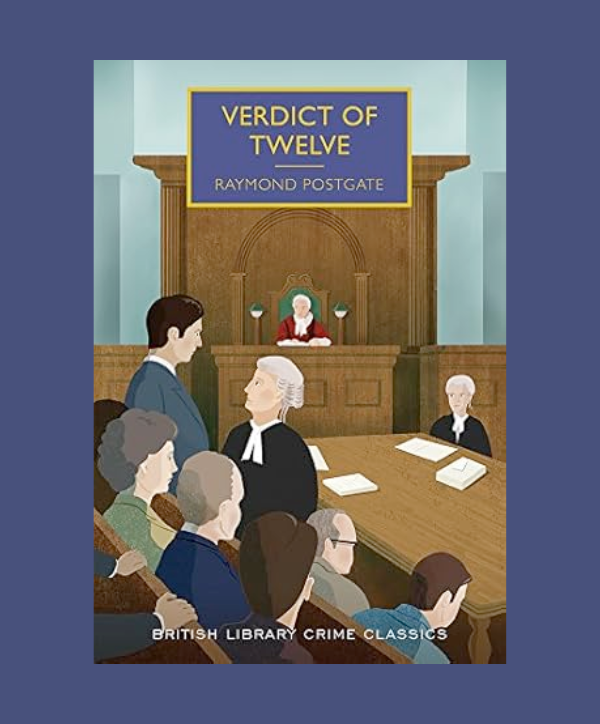
I read Verdict of Twelve by Raymond Postgate as part of Oundle Crime’s reading theme for March, which was Classic Crime (Golden Age or modern). It’s an intriguing book, and it felt so different from so much courtroom crime fiction that I thought it deserved a standalone review. So here it is!
Having read this, I wanted to find out more about the author – someone I had never heard of before. It turns out that Raymond Postgate (1896-1971) was a complicated man. The son of a well-to-do professor, he early in life abandoned his wealthy background, became first a Communist, later a member of the Labour Party, and was a lifelong, committed socialist. He was also a proponent of good food and founded what he called ‘The Society for the Protection of Good Food’, which was later renamed The Good Food Guide.
By profession, Postgate was a journalist and historian as well as a writer. He came to writing fiction late in life and Verdict of Twelve was his first novel, published in 1940. It reflects his views and his take on how British society saw people of difference. For quite a while the book was very influential but eventually disappeared into obscurity; and although he wrote two further detective stories, both sank without a ripple.
As the title suggests, this is the story of a murder trial by jury and is set in the 1930s. The reader is plunged straight into the action, with the swearing-in of the individual jurors without any explanation as to what is going on. The first juror is a woman of very low origin who had grown up in Cambridge in the early 1900s. We hear a detailed account of her unpleasant family, her dishonest ways of making a living, and of the murder she successfully committed to gain access to money that set her up in a respectable trade. It was a shocking introduction and in the following chapters we meet the other jurors. The first five get a chapter each, the rest get a page or two each in the chapter that follows.
The jurors range from a grossly conceited Oxford don who thinks he should be the jury foreman simply because he is who he is, through all manner of different professions. There’s a publican, a union chairman, an actor, the woman who was herself a killer, but who got away with it, and a successful Greek immigrant, who has tried very hard to hide his origins.
It’s only after all these characters have been introduced that we learn of the crime. A woman of low class stands accused of killing a young boy. He had been the heir to his West Country grandfather’s estate and fortune and was the only one standing in the way of her (his aunt by marriage) getting her hands on this fortune. The crime itself is unusual, involving a rare poison and a completely incompetent but innocent doctor.
The court scenes introduce us to the judge and the barristers (all complete caricatures of such people) and then follows the jury deliberation. Here we find how much the jurors are affected in their thinking by their own background and concerns; and how impossible most of them find it to concentrate on the details of the case and divorce themselves from their own private lives and worries. And now the long introduction to the jurors pays off, because not only is it a good deal easier to tell them apart, but it also made me see just how difficult it must be to become a juror. It was surprisingly thought-provoking.
My verdict
The jury’s verdict came as a surprise and I’m still not sure if the verdict was right – if the woman was guilty or not. As the reader I had to make up my own mind.
It is a surprisingly good book. The writing style is rather dry and very meticulous but Raymond Postgate does create a vivid picture of all the characters. And yes, it is very dated in style and story, but that is only to be expected. In spite of its shortcomings, I did enjoy reading it and, as I say, I found it intriguing.
Verdict of Twelve is published in the British Library Crime Classics collection and has a foreword by the crime writer, Martin Edwards. I do recommend reading the foreword because it’s both interesting and illuminating. This is a Golden Age novel that’s worth reading and I give it 4 Stars.
Review by: Freyja
What’s in a Star?
Deciding why you like an author or have enjoyed a book is, of course, entirely subjective, and everyone who comes along to meetings of Oundle Crime has different tastes. So how do we try to get some consistency in our Star ratings? Well, after some discussion, we’ve come up with the following:
- 5 Stars: Outstanding and unforgettable. A book you can’t wait to tell others about.
- 4 Stars: A good book with an interesting, layered story that you will still remember after a month.
- 3 Stars: Not good or bad, but an average story and characters. You enjoyed reading it, but might not remember it after a month.
- 2 Stars: Poorly written, superficial and probably a bit of a yawn. Forgettable.
- 1 Star: Rubbish through and through. A book you wish you hadn’t read and don’t want to remember!
If you’d like to meet other crime fiction fans and chat about the books and authors you enjoy, why not come along to an Oundle Crime meeting? It’s relaxed and friendly, and anyone can drop in. Email join@friendsofoundlelibrary.org.uk and we’ll send you the details.