
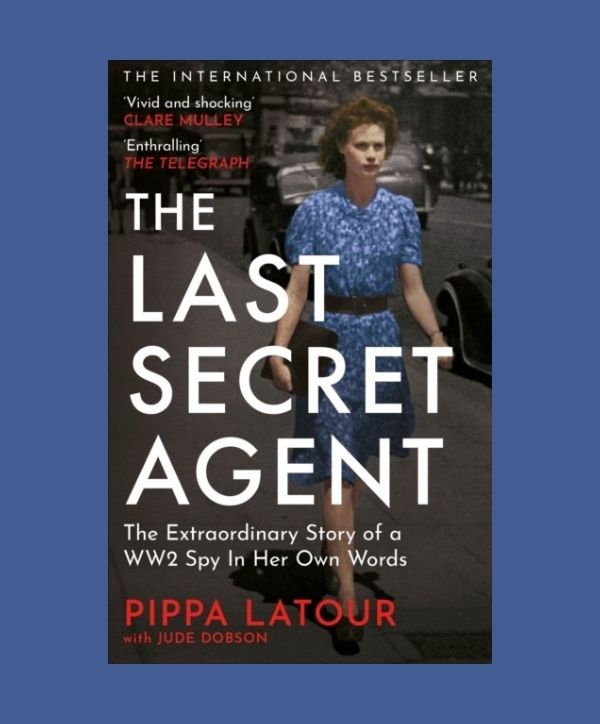
I saw this book in a list of The Independent’s 23 Best Audiobooks, published earlier this year. It looked interesting, so I ordered a copy from the library and it was so good I gulped it down in record time.
Pippa Latour was only 23-years-old when in 1944, in the lead-up to D-Day, she was parachuted into France behind enemy lines. As an SOE wireless operator, she was to report back to London on German troop movements and more, helping to clear the way for the landings. She was the first, and last, female secret agent to write about her experiences.
The Last Secret Agent isn’t a long book, but I found it completely gripping. To set the scene there’s a moving Foreword by the former Commanding Officer of the New Zealand SAS, followed by a Preface that begins: “My name is Phyllis Ada Latour, known to many in my later years as Pippa, and I am 102 years old. I am also known by other names – code names and alias names – because I was a World War II secret operative agent. This is my memoir…”
The idiom ‘tight lipped’ could have been invented to describe Pippa Latour. This remarkable woman survived the war and decided in 1945 that she would never, ever speak about what she had done. And she didn’t. But when she was in her eighties and living in New Zealand, her elder son found something about her on the internet and asked a direct question. Still, she refused to say much, citing the Official Secrets Act. It was only later, after she’d been told the Official Secrets Act was no longer a problem for her, that she was persuaded to write her memoir. She did so because she’d seen the untruths that people were writing and wanted to put the record straight.
Her story is fascinating. Born in South Africa (and that’s a story in itself) her father was killed in an uprising in the Belgian Congo when she was just four months old. A few years later her mother died suddenly, so Pippa was then brought up by her wider family and godmothers, moving to live with new people in new places throughout her childhood.
When she was fifteen years old it was decided she should go to live in Paris with one of her godmothers, to polish up her French and English. She was already fluent in Walloon, Flemish and Swahili, with enough Kikuyu and Afrikaans “to get by” and a smattering of German and Italian. She also was extremely good at mathematics and loved numbers and patterns, having learned Morse code and algebra from the age of seven.
So it was that Pippa was in Paris in the years before World War II and witnessed first-hand the tensions in Europe, as Hitler first annexed Austria and Sudetenland, and then the rest of Czechoslovakia, before invading Poland. Knowing France would be next her family managed to get her to England, where she went to live with more relatives in Portsmouth.
In England she did various jobs before she was recruited to the Special Operations Executive (SOE) and, after just a few months training, she was told she would be dropped by parachute into Normandy to be a wireless operator. Her role was to be a roaming one, because it wouldn’t be safe for her to stay in one place for long. She had to be on the road, gathering intelligence and sending that and information from others, back to London.
In her Preface to The Last Secret Agent, Pippa describes her time behind enemy lines as “a hellish existence” but I suspect that the life she describes isn’t a fraction of what she actually endured. To read the details is sobering and difficult, because I don’t think my wildest imaginings could come close to the stress and tension she must have lived with day after day, after day. Obviously, she was brilliantly good at what she did: ingenious, clever, quick-thinking and beyond courageous. And let’s not forget that for probably 80-90% of her time she was operating behind enemy lines entirely unsupported.
Told in her own words, this is an extraordinary account of an almost unbelievable life; and even though the telling is matter-of-fact it’s very, very readable, because Pippa Latour was without hubris. And while this makes it sound as if she came through the war relatively unscathed, of course she didn’t. I don’t suppose anyone who did what she did, could have. This memoir is her story and it’s also a testament to everyone who worked for SOE, particularly the 39 women agents who were in France, of whom fourteen never returned.
I thought this was a wonderful book and definitely worth 5-Stars. It’s gripping and incredibly moving too. Do read it if you can.
Review by: Cornish Eskimo
What’s in a Star?
On these pages we work on the basis that 5 Stars = “Outstanding and unforgettable. A book you can’t wait to tell others about.